Boy, Was I Wrong: The Taliban Didn't Need to Be Different
Almost five years ago, I claimed that the Taliban would need to govern Afghanistan differently this time. I made three charts, and I felt pretty pleased with myself.
Things didn't exactly pan out the way I hoped.
- 2.4 million girls are now barred from secondary school, up from 1.4 million two years ago and on track for roughly four million by 2030.
- Women have been banned from universities since December 2022.
- Unexpectedly, boys are collapsing too: male university enrolment fell from 310,369 in 2019 to 188,957 in 2024, and 40% of the 2.13 million primary-age children out of school are boys.
- Female university faculty have fallen 70%, from 2,599 to 794, and UNESCO projects a shortfall of more than 11,000 qualified female teachers by 2030.
- Because the regime requires female-only instruction for girls, it has built a constraint that will outlast its own decision. Even if the ban were lifted tomorrow, there'd be nobody left to teach them.
I was wrong, and wrong very publicly. At the risk of being wrong-er and public-er, let's give it another whirl.
1. The internet arrived in Afghanistan, and then it stopped arriving
This is the chart I got least wrong, and there's one specific line in the original I'd like to smugly point at before I start revising everything else. I wrote that the Taliban could shut down the internet, but that "no matter how many times governments around the world shut down the internet, they always have to turn it back on."
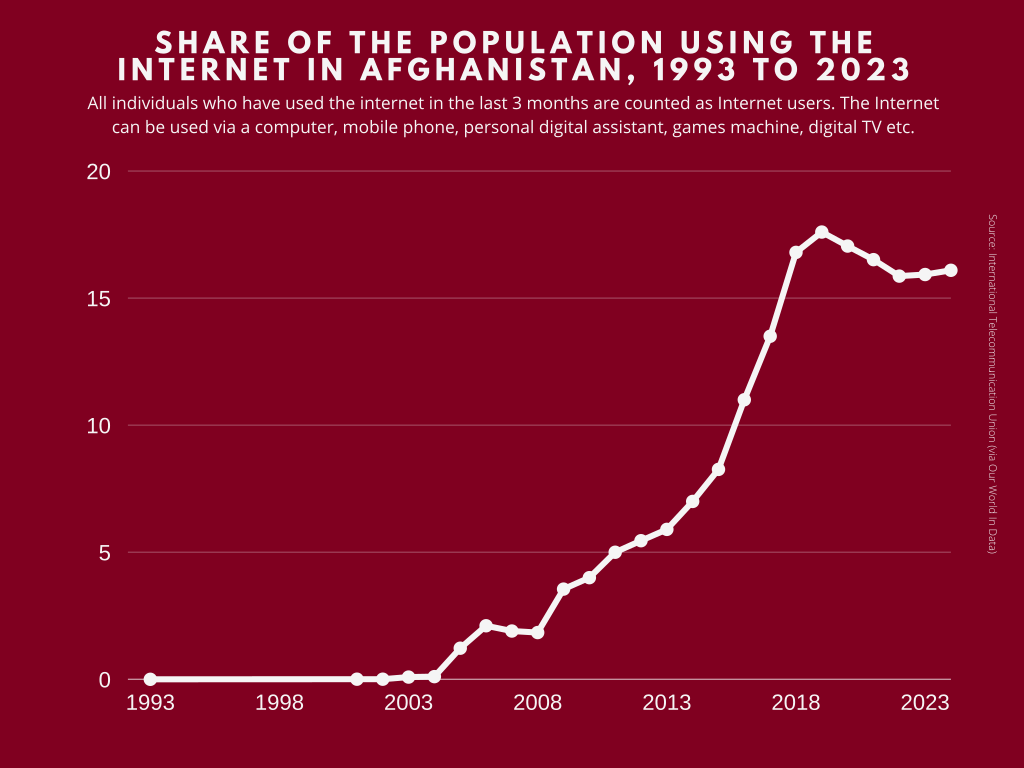
In late September 2025, the Taliban cut the fibre-optic backbone and imposed a nationwide internet and mobile blackout, citing the prevention of "immoral activities." Banking stopped. Hospitals stopped. Airports stopped. Visa issuance stopped. They turned it back on after about 48 hours.
I'll take a small victory lap on this one: the regime swung big, paid a real and immediate cost, discovered it couldn't sustain the position, and walked it back within two days. The fundamentalist wing would love to seal the country off from the world. On the available evidence, it can't.
What I did get wrong is the shape of the line. I assumed connectivity would keep climbing, because that's what it had done every year for twenty years. Instead it froze. ITU figures put internet penetration at 17.6% of the population in 2019, and it hasn't recovered that level since. So while they can't disconnect Afghanistan, they have successfully stopped it connecting any further.
And one number is sobering. Of Afghanistan's five million social media users, 86.1% are men. Whatever information channel survived the takeover, women are mostly not on it.
2. The chart that remains misleading
In 2021, I wrote that over 85% of Afghan children completed primary school, against 28% under Taliban rule in the late 1990s, with 67% of girls completing.
Firstly, I really should have been looking at secondary school enrolment, and specifically at the gap between girls and boys, since the suppression of girls' education was the concern at the time and is exactly what the Taliban have gone on to do.
So here's the chart I should have made. In Afghanistan, lower secondary is grades 7 to 9. The Taliban's ban applies to everything above grade 6. These are, precisely and exactly, the years girls are forbidden to attend.
Enrolment of girls in them has gone up. From somewhere above 55% in 2021 to almost 65% today.
Under the Taliban.
In the period they banned girls from secondary school.
Which is, obviously, nonsense.
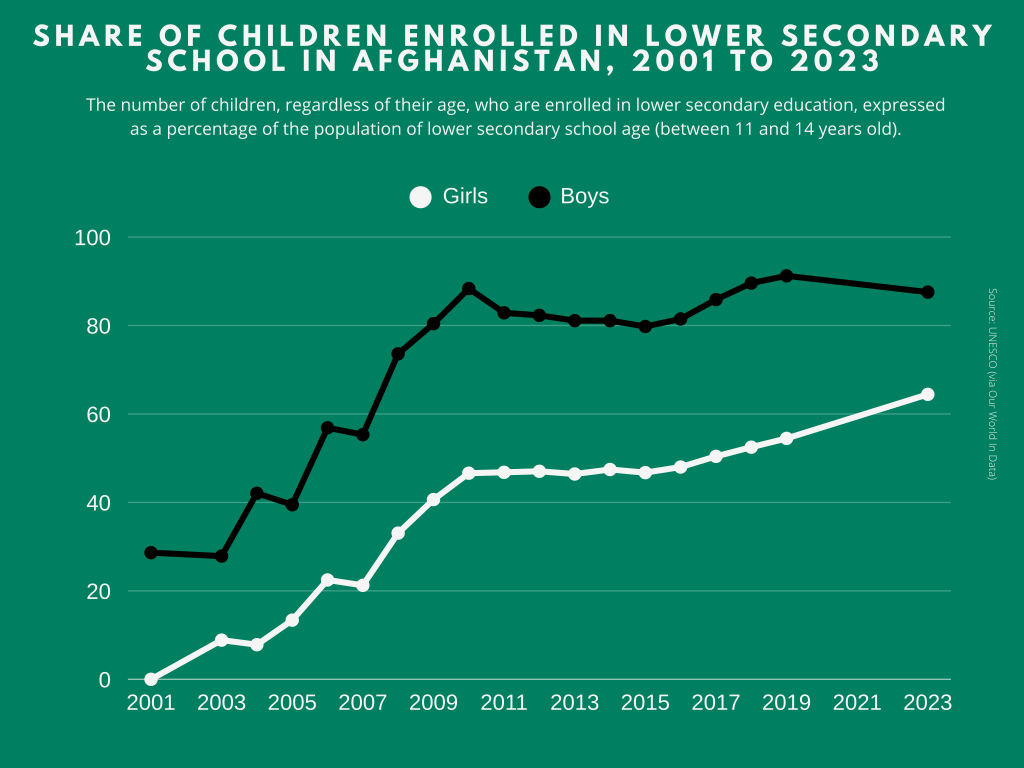
UNESCO's 2025 situation report explains that the de facto Ministry of Education lets students stay registered for three years without anyone verifying whether they turn up. The Ministry's information system records 1.08 million girls enrolled in secondary school in 2024. The field-verified number of girls above grade 6 since 2022 is zero.
So I can't update this chart. The only institution producing Afghan education statistics is the institution being assessed by them, and it has every reason to keep the line going up.
3. People experience healthier outcomes, for some reason
The third chart measured the burden of communicable, maternal, neonatal and nutritional disease, in disability-adjusted life years per 100,000 people. One DALY is one lost year of healthy life. In 2021 I said we'd halved it, from about 40,000 in 1994 to under 15,000. (The maths was also wrong, by the way. That's a 70% fall, not a halving. It's been a humbling experience.)
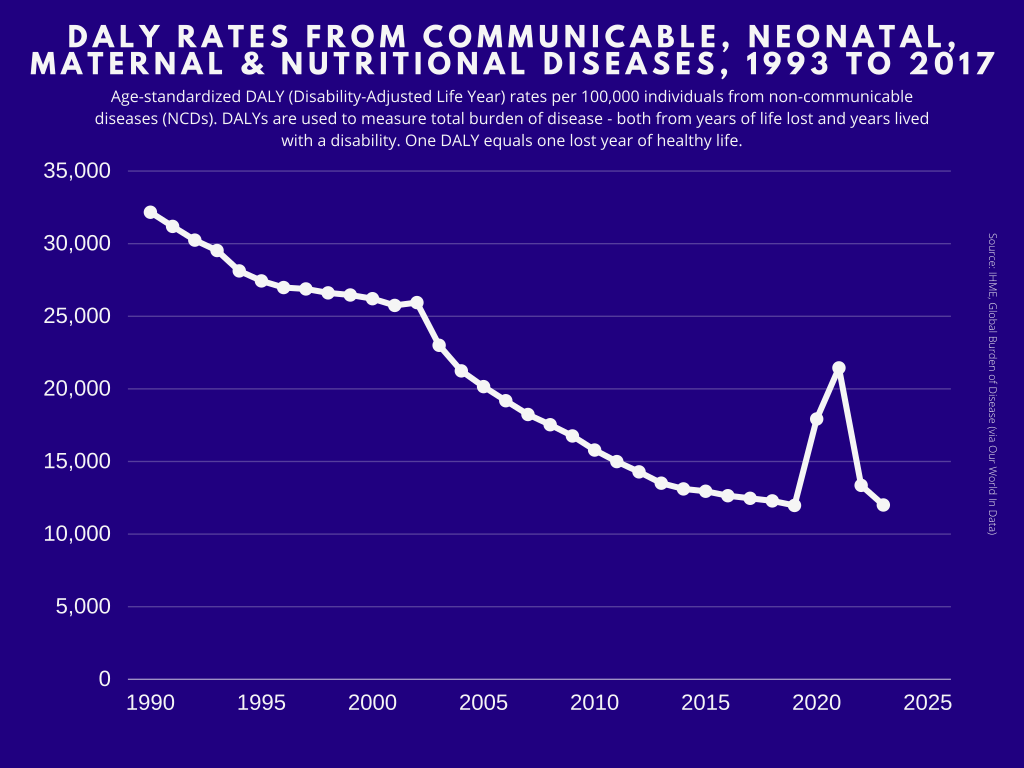
It was 12,465 DALYs in 2017, where my original chart ran out. It spiked to 21,446 in 2021. And in 2023, the most recent year available, it's 12,005.
The spike is probably some combination of COVID and the US withdrawal: Afghanistan's Delta wave peaked in mid-2021 with almost no vaccination coverage, and the withdrawal completed in August of the same year. Two enormous events, one annual datapoint, and no honest way to separate them.
The 2023 figure is what I can't explain. Twelve thousand is lower than 2017. Under the Taliban, with development aid collapsed, the banking system severed from the world, and a health system running on emergency humanitarian funding, this measure didn't just recover, it passed where it was before the republic fell. Maybe the aid-funded vertical programmes for vaccination, maternal care and nutrition are genuinely working, even as everything around them degrades. But I suspect the answer is duller than that: the data ends in 2023, the United States withdrew its assistance in 2025, and the frontline reporting on maternal, neonatal and child deaths since then is grim in a way no chart here reflects. None of that will show up in this series until 2027 or 2028. So I think this is mostly measurement lag, but I welcome alternative explanations from anyone better informed than me.
My larger error
What I got wrong was the rationale. My thesis was that material reality would constrain ideology: that a connected, educated, healthier Afghanistan would force the Taliban into compromise whether they liked it or not. And on things with immediate economic upside, like the internet, that's roughly what happened. On women and girls, it didn't, because I'd quietly assumed the regime would treat the costs of gender-based repression as prohibitive. It didn't. It looked at diplomatic isolation, frozen reserves, a collapsed economy and the loss of half its human capital, and paid the bill.
My error is more a failure of imagination, and of understanding the Taliban's incentives, than a forecasting error. I could build a reasonable mental model of the constraints. I couldn't imagine someone willing to simply swallow them.
A bald-faced, shameless attempt at doing it again
Having established that I'm bad at this, here are four falsifiable predictions for August 2031:
- The ban on girls' secondary education is still in place, in substance if not in name. Partial re-openings, religious-school workarounds and province-level exceptions are likely; a genuine national restoration is not.
- Enrolment doesn't recover, even if the ban is lifted. The female-teacher shortfall is the binding constraint, and it's now baked in for a decade regardless of policy.
- Afghan health indicators visibly deteriorate in the data by 2029. Not because things get worse then, but because that's when 2025 shows up.
- At least one Western government substantively normalises relations. The post-USAID pragmatism will endure, and migration management and counter-narcotics will drive national governments to re-engage.
The lesson I hope outlives the war
The Trojan War has been useful to humanity for three thousand years. It's a story compact enough to survive translation into every era that follows: a great power, a long war, a homecoming, trials and tribulations. Nolan's film means everyone has opinions about Ithaca this year, so with that in mind, I'd like Afghanistan to be added to the pantheon of timeless parables. That's in many ways why I've written this update.
The United States, the most powerful and influential hegemon in the history of humanity, could not remake Afghanistan. Trillions of dollars spent, countless lives lost.
And the Taliban cannot unmake Afghanistan by decree, and found that out in 48 hours when they switched off the internet and the banks stopped working.
Two ideologies, opposite directions, same wall. A country is not a project.
The people paying for the world absorbing these lessons are 2.4 million girls who did not go to school today and might never learn to read. That's the part I'd want a parable to carry, if we get one. Not what the superpower learned. Who was sacrificed on the altar of history.