Which Founder CEO archetype are you working with?

I’ve semi recently had a realisation after a few people pointed it out to me: I’ve only ever worked with Founder CEOs. At first, I was incredulous, but looking back at my career I realised it’s true. I also realised that I’d been building a bit of a mental model for them and how they functioned.
Having now worked closely with at least five founders across the Effective Altruism/non-profit social impact space as their right-hand operations person, and with enough scar tissue to show for it, I lay out the framework I wish I'd had at the start: a way to categorise founder types and, more importantly, tips for working with each.
The two axes that matter ↕️↔️
Founders differ fundamentally along two dimensions:
X-axis: Source of Authority
- Domain Expertise. These founders derive credibility from deep technical knowledge or mastery of their field
- Strategic Vision. Founders who derive credibility from big-picture thinking and long-term organisational direction
Y-axis: Response to Uncertainty
- Trust-Building. Founders who, when uncertain, they delegate, seek input, and empower others
- Control-Seeking. Founder who, when uncertain, they centralise control, micromanage, and avoid delegation
These two dimensions create four distinct founder archetypes, each requiring different approaches.
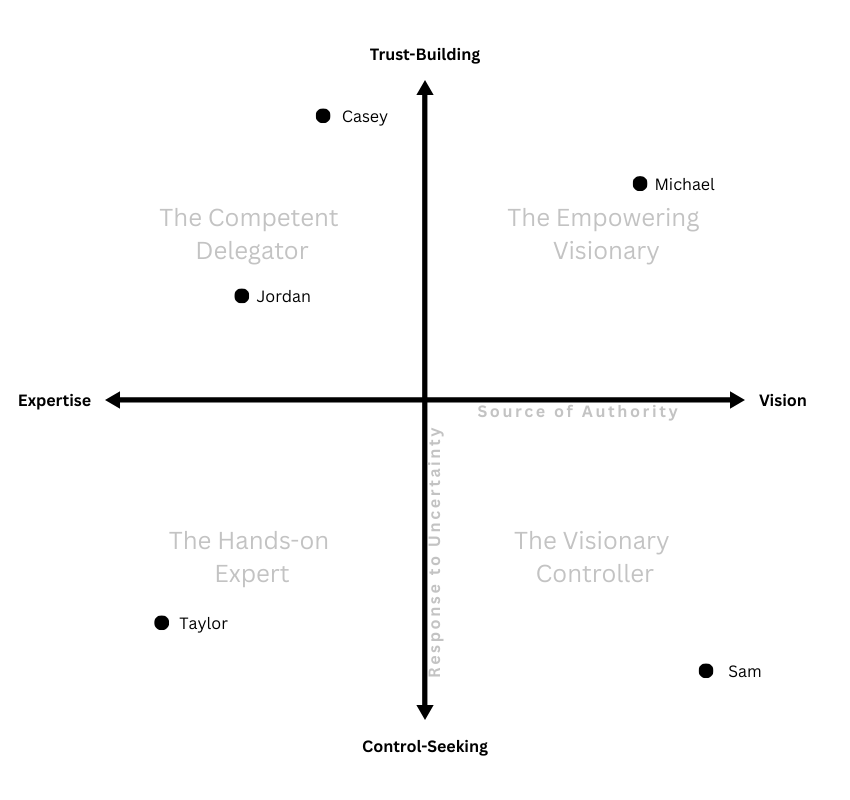
The four founder types 4️⃣
The Hands-on Expert (High Expertise + Control-Seeking)
I worked with Taylor, who ran a consulting firm and held a doctorate in the exact services we sold. Clients literally came for Taylor's expertise, not anyone else's. Initially, Taylor gave me significant autonomy to handle operations and business development. But when we ventured into unfamiliar territory in which we were both figuring things out as we went along (e.g. marketing, sales processes, growth strategy), the micromanagement intensified dramatically.
Taylor would scrutinise my work in areas outside their expertise with the same rigour they applied to their own technical work. What they couldn't control through expertise, they tried to control through micromanagement. The irony was that their technical brilliance in one domain created blindness about their limitations in others.
The Competent Delegator (High Expertise + Trust-Building)
I've worked with two separate founders who fit this mould: Jordan and Casey.
Jordan came from a science background but wasn't an expert in the non-profit's intervention. However, they recognised this gap immediately and worked relentlessly to close it. Within what I perceived to be only a few months, Jordan knew the intervention better than anyone in the organisation. They were highly analytical — spotting flaws in my work with surgical precision — but only became deeply involved in areas they deemed critical (legal risk, key hires). For everything else, Jordan trusted the team to execute.
Casey was perhaps the most paradoxical founder I've encountered. They'd started multiple projects independently and exhibited extensive experience in leading them. In areas core to their worldview and expertise, they exerted intense, almost obsessive scrutiny. But for execution details they deemed less critical? Complete autonomy, as long as you delivered results.
Casey taught me something crucial: founders can be both analytical and gut-driven, depending on what they perceive as high-stakes. They operate in a secret language of priorities, and your job is to learn that language.
The Visionary Controller (High Vision + Control-Seeking)
In addition to founding a non-profit, Sam had studied grassroots development and social enterprise models extensively. They knew exactly what the organisation should become, and the vision was crystal clear in their mind. The problem? When that vision was questioned or when implementation hit messy reality, Sam became defensive.
Sam cared deeply about their "baby" and took challenges personally. Every strategic disagreement felt like an attack on their judgment. I learned quickly that political capital was finite and that I had to pick my battles carefully. Some hills weren't worth dying on.
The Empowering Visionary (High Vision + Trust-Building)
What it looks like in practice: Michael is perhaps the most ambitious founder I've worked with. No challenge is too big; they're always thinking three moves ahead with grand aspirations for the future. Michael gave me more autonomy than any other founder.
Michael is highly analytical (even more so than Casey), but their pragmatism sometimes veers into tunnel vision. They're so focused on the long-term vision that short-term reality can become background noise. Ideas that align with the strategic vision get greenlit quickly — sometimes too quickly, without sufficient scrutiny of implementation challenges.
What this framework teaches us
Beyond just categorisation, this framework reveals something important about the right-hand role: there is no universal playbook for working with founders. The strategies that work brilliantly with a Competent Delegator will backfire spectacularly with a Visionary Controller.
The control-seeking founders (Hands-on Expert and Visionary Controller) require careful political capital management and strategic communication. You need to pick your battles, speak their language, and recognise when to push back versus when to execute loyally.
The trust-building founders (Competent Delegator and Empowering Visionary) require early competence signals and then consistent delivery. They'll give you rope, just don't hang yourself with it.
The expertise-driven founders (Hands-on Expert and Competent Delegator) need you to demonstrate domain knowledge or at least deep curiosity. They respect technical chops.
The vision-driven founders (Visionary Controller and Empowering Visionary) need you to connect with their strategic thinking. They respect systems-level understanding.
A final thought on founder-operator dynamics
The most valuable lesson from mapping these five founders isn't the taxonomy itself, it's the recognition that founder behaviour follows some semi-predictable patterns.
When I started my second role, I was frustrated that my first-founder strategies weren't working. I thought I was the problem. Now I realise I was just using the wrong playbook for a different game.
If you're considering a right-hand role—Chief of Staff, Director of Operations, or any founder's-right-hand position—spend your first month mapping your founder onto these axes. It'll save you months of interpersonal friction and help you understand which battles to fight, which language to speak, and which strategies actually work. I can also highly recommend ‘The First 90 Days’ by Michael D. Watkins as a thought-provoking and useful read before starting in such an influential role.
The right-hand role is not about being universally competent. It's about being situationally adaptive. And adaptation requires pattern recognition.